

Understanding Calcium Score Limitations in Detecting Plaque Types and the Role of Advanced Lipid Testing
- wellonee
- Apr 12
- 5 min read
Heart disease remains a leading cause of death worldwide, making early detection of risk factors critical. One common tool used to assess heart disease risk is the calcium score, which measures the amount of calcified plaque in the coronary arteries. While useful, calcium scoring has important limitations. It detects only hard, calcified plaque and misses soft plaque, which can be more dangerous PMID: 41488027; PMID:37821352; real world evidence. This post explains why calcium scoring cannot detect soft plaque, clarifies the differences between plaque types, and highlights why advanced lipid testing offers a more complete picture of cardiovascular risk than standard cholesterol tests.
What Is Calcium Scoring and What Does It Detect?
Calcium scoring uses a specialized CT scan to identify calcium deposits in the coronary arteries. These deposits form when plaque in the arteries hardens over time. The test produces a score that reflects the total amount of calcified plaque present.
Key points about calcium scoring:
It detects calcified (hard) plaque only.
It provides a measure of the burden of existing calcified plaque.
A higher calcium score generally indicates a higher risk of heart disease.
It does not detect soft plaque, which is not calcified.
Because calcium scoring relies on detecting calcium, it cannot see plaque that has not yet hardened. This limitation means it may underestimate risk in people with significant soft plaque buildup.
Understanding the Three Types of Plaque
Plaque in the arteries forms from a combination of cholesterol, fat, calcium, and other substances. It narrows arteries and can lead to heart attacks or strokes. There are three main types of plaque:
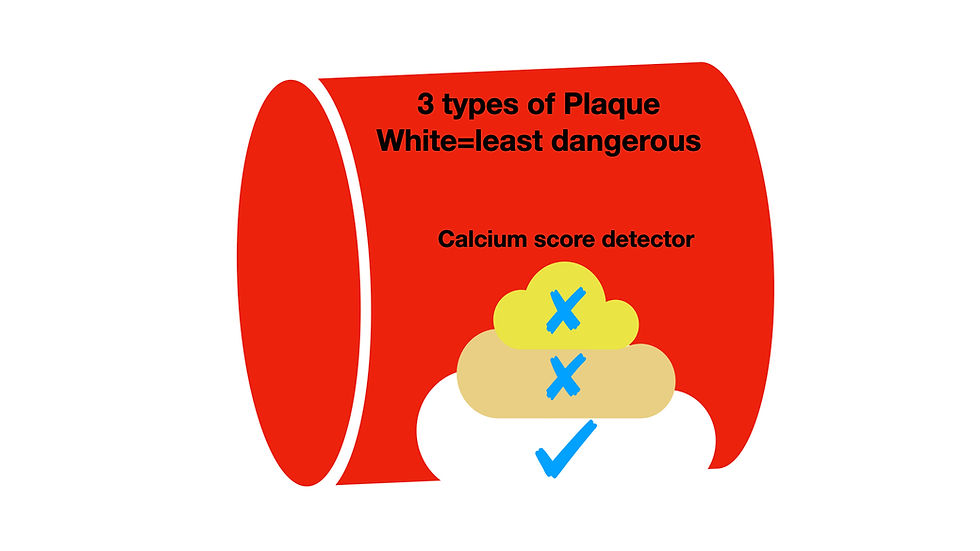
Calcified Plaque (Hard Plaque; white in the image)
Contains calcium deposits.
Visible on calcium scoring scans.
More stable and less likely to rupture suddenly.
Indicates longer-term, chronic artery disease.
Calcium buildup increases with age and disease progression.
Non Calcified Plaque (Soft Plaque; beige in the image)
Contains both soft and hard components.
Partially visible on calcium scoring.
Represents a transition stage in plaque development.
3. Low Density Non-Calcified Plaque (Ultra Soft Plaque; yellow)
Made mostly of cholesterol and fatty deposits.
Does not contain calcium, so it is invisible on calcium scoring scans.
More unstable and prone to rupture.
Rupture can cause sudden blood clots, leading to heart attacks.
Often found in younger patients or early stages of artery disease.
The critical point is that soft plaque is often the most dangerous because it can rupture without warning. Calcium scoring misses this risk entirely, which can give a false sense of security.
Why Calcium Scoring Alone Is Not Enough
Calcium scoring is a valuable tool but has limitations:
It cannot detect soft plaque, so it may miss early or unstable disease.
A zero calcium score does not guarantee no risk of heart attack.
It provides no information about the size or composition of soft plaque.
It does not measure other risk factors like inflammation or cholesterol particle size.
For example, a middle-aged person with a zero calcium score but high levels of soft plaque could still be at significant risk for a heart attack. Relying solely on calcium scoring may delay necessary treatment or lifestyle changes.
The Importance of Advanced Lipid Testing
Standard cholesterol tests measure total cholesterol, LDL ("bad" cholesterol), HDL ("good" cholesterol), and triglycerides. While useful, these tests do not reveal the full picture of cardiovascular risk.
Advanced lipid testing goes deeper by measuring:
LDL particle number and size: Small, dense LDL particles are more likely to penetrate artery walls and form plaque.
Lipoprotein(a): A genetic risk factor linked to plaque buildup and heart disease.
Apolipoproteins: Proteins that carry cholesterol and fats in the blood, providing insight into risk.
Inflammatory markers: Some advanced tests include markers of inflammation that contribute to plaque instability.
These tests help identify hidden risks that standard cholesterol panels miss. For example, a person with normal LDL cholesterol but a high number of small LDL particles may have a higher risk of soft plaque formation.
See here for advanced lipid testing. No MD order needed.
How Advanced Lipid Testing Complements Calcium Scoring
Combining calcium scoring with advanced lipid testing offers a more complete assessment:
Calcium scoring shows the amount of hard plaque already present.
Advanced lipid testing reveals risk factors for soft plaque formation and instability.
Together, they help doctors tailor prevention and treatment strategies.
Patients with low calcium scores but high-risk ADVANCED lipid profiles can receive early intervention.
Those with high calcium scores and adverse ADVANCED lipid markers may need more aggressive management.
Why is all this testing needed
Number one is to prevent a fire before it starts
Number two this prevention intervention measures hinges on each person's biology and response. Must be tailored to genetics and plaque phenotype.
This is very tricky and needs patient, molecular guide, and provider to be all hands on deck, since the science is not all there yet.
The good news: because heart disease impacts so many, we know far more today, unlocking well established personalization strategies tailored to individual biology.
Ways to Get Advanced Lipid Testing
Ask your doctor to order an advanced lipid panel using codes E78.00 or Z86.79
Order it yourself, go to quest, get results in seven days
Order a home kit. Benefits 1. you can test a lot more than just advanced lipids, like metabolic, thyroid, sex hormone markers 2. small volume of blood required 3. regular testing (once a month) right at home (regular testing is important for tracking intervention response) 4. Syncs wearables 5. MD consult
Subscribe to a functional medicine platform like Ultrahuman or Mitohealth
Practical Steps for Patients and Providers
Discuss both calcium scoring and advanced lipid testing with your healthcare provider if you have risk factors like family history, high cholesterol, or diabetes.
Understand that a zero calcium score does not mean zero risk.
Ask about advanced lipid testing to uncover hidden risks.
Use test results to guide lifestyle changes, medications, or further testing.
Regular monitoring can track changes in plaque and lipid profiles over time.
If a provider dismisses advanced testing you can get one on your own by autonomously testing
If advanced lipids are elevated ask your doctor for a CCTA with AI guidance (advanced imaging detecting all plaque), not just the more stable hard plaque.
A significant number (>90%) of cardiologists go straight to calcium scoring and basic cholesterol panels due to guideline support, reimbursement and simplicity (not many are well studied on lipid mechanics), which miss significant risks.
Always operate with this well known fact: 50% of sudden cardiac deaths strike folks with no prior symptoms and many have acceptable lipid numbers, but unknown advanced lipid levels.
Summary
Calcium scoring is a useful tool for detecting hard, calcified plaque but cannot see soft plaque, which often poses a greater risk of heart attack. Understanding the differences between soft, hard, and mixed plaque is essential for accurate risk assessment. Standard cholesterol tests do not capture the full picture of cardiovascular risk, making advanced lipid testing a critical complement. Together, these tests provide a clearer view of heart health and help guide effective prevention and treatment strategies.
Taking a comprehensive approach to heart disease risk assessment can save lives by identifying hidden dangers early and supporting personalized care plans. If you are concerned about your heart health, talk to your doctor about both calcium scoring and advanced lipid testing to get the most accurate evaluation possible.


Comments