

Is Apolipoprotein B and Lipoprotein A More Predictive of Heart Disease Risk
- wellonee
- Mar 31
- 4 min read
Heart disease remains the leading cause of death worldwide, making accurate risk prediction essential for prevention and treatment. Traditional cholesterol tests, such as LDL and HDL levels, have long been used to assess cardiovascular risk. Yet, recent research suggests that two other markers, apolipoprotein B (ApoB) and lipoprotein(a) [Lp(a)], may offer stronger predictions of heart disease risk. This post explores how ApoB and Lp(a) compare to traditional lipid measurements and what this means for assessing heart health.
Understanding Apolipoprotein B and Lipoprotein(a)
Before diving into their predictive power, it helps to understand what ApoB and Lp(a) are.
Apolipoprotein B (ApoB) is a protein that takes bad lipids to their destination and found on the surface of several lipoproteins, including LDL (low-density lipoprotein), VLDL (very low-density lipoprotein), and others that carry cholesterol through the bloodstream. Each of these particles contains one ApoB molecule, so ApoB levels reflect the total number of potentially harmful cholesterol particles https://doi.org/10.1161/JAHA.122.025858
Lipoprotein(a) [Lp(a)] is a type of LDL particle with an additional protein called apolipoprotein(a). Elevated Lp(a) levels are largely determined by genetics and are linked to increased risk of atherosclerosis, blood clots, and heart disease https://doi.org/10.1161/JAHA.122.025858
Both markers provide insight into the number and type of cholesterol particles, which may be more relevant to heart disease risk than just measuring cholesterol content alone.
Why Measuring ApoB and Lpa Can Lead to Personalization
Because people differ genetically, variants in genes like APOB, LDLR, LPA, APOE can strongly influence how someone handles Lpa, LDL, and triglyceride rich proteins. What worls fo rone person can backfire for another. Some people do best on a plant based, lower fat, high fiber pattern that reduces LDL and ApoB, while others with prominent TLR-drive dyslipedemia or insulin resistance may respond better to a well formulated, low carb keto approach that tames triglycerides.
Herbs like fenugreek, bergamot, cinnamon, and others can further fine tune PMID: 10540988; PMID: 39935620; PMID: 40507140; PMID:29747751; PMID:17928472
Additionally, medications are can also be tailored based on pharmacogenomics PMID: 32735150
Why Traditional Cholesterol Tests May Fall Short
Standard lipid panels measure:
LDL cholesterol (LDL-C)
HDL cholesterol (HDL-C)
Total cholesterol
Triglycerides
These tests estimate the amount of cholesterol carried by lipoproteins but do not count the number of particles. This can be misleading because:
Two people with the same LDL-C level may have different numbers of LDL particles.
Smaller, denser LDL particles are more atherogenic (likely to cause plaque buildup) than larger ones.
LDL particle number correlates better with cardiovascular risk than LDL-C alone.
Because ApoB represents the number of atherogenic particles, it can provide a clearer picture of risk. Similarly, Lp(a) is not routinely measured but has unique properties that increase cardiovascular risk independently of LDL-C.
Evidence Supporting ApoB as a Stronger Predictor
Several large studies have compared ApoB with traditional cholesterol measures:
A 2018 meta-analysis published in the Journal of the American College of Cardiology reviewed data from over 300,000 individuals. It found that ApoB predicted cardiovascular events better than LDL-C and non-HDL cholesterol PMID: 21487090
The European Society of Cardiology now recommends ApoB measurement in patients with high triglycerides or diabetes, where LDL-C may underestimate risk.
ApoB testing can identify patients who may benefit from more aggressive cholesterol-lowering therapy despite having “normal” LDL-C levels.
Example: A patient with LDL-C of 100 mg/dL but elevated ApoB may have many small LDL particles, increasing their risk. Traditional tests might miss this, but ApoB measurement can guide more personalized treatment.
The Role of Lipoprotein(a) in Heart Disease Risk
Lp(a) is less well-known but gaining attention:
Elevated Lp(a) levels are present in about 20% of the population and are mostly genetically determined.
High Lp(a) is associated with increased risk of coronary artery disease, stroke, and aortic valve stenosis.
Unlike LDL-C, Lp(a) levels do not respond well to lifestyle changes or most cholesterol-lowering drugs.
New therapies targeting Lp(a) are under development, making testing more relevant.
Example: A person with normal LDL-C but very high Lp(a) may have a higher risk of heart attack than expected. Identifying this risk can prompt closer monitoring and consideration of emerging treatments.
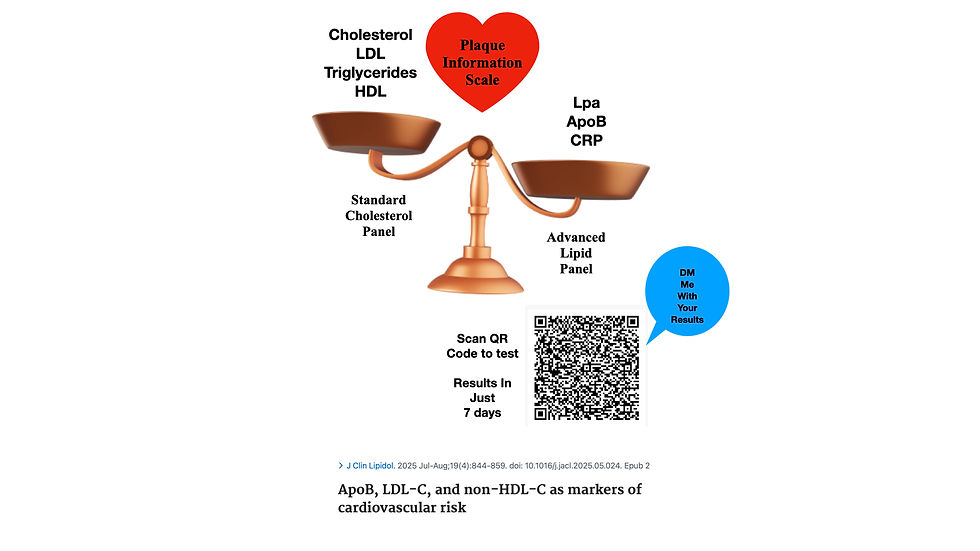
A scale weighing different biomarkers QR code shows where to get the tests
How ApoB and Lp(a) Testing Can Change Patient Care
Incorporating ApoB and Lp(a) into cardiovascular risk assessment offers several advantages:
More accurate risk stratification: Patients with borderline or normal LDL-C but high ApoB or Lp(a) can be identified as higher risk.
Personalized treatment decisions: Doctors can tailor therapies based on particle number and Lp(a) levels, potentially prescribing stronger statins, PCSK9 inhibitors, or considering clinical trials. Functional/Integrative cardiologists can use the information to tailor supplements or food.
Better monitoring: ApoB levels respond to treatment and can be used to track therapy effectiveness.
Family screening: Because Lp(a) is inherited, testing can identify family members at risk.
Practical Considerations for Testing
ApoB and Lp(a) tests are available through most clinical laboratories but may not be included in standard lipid panels. Test here if you prefer home testing solutions or here if you want to go to a standard lab
Advantages/Disafvantages of the home test kit: MD consults, dashboard to sync wearables like oura, garmin, etc... Disadvantages: does not test particle size
Advantages/Disadvantages: Tests particle size Disadvantages: Does not have an MD on board to review and no dashboard
Insurance coverage varies; patients should check with providers. Some of these tests are sometimes covered by insurance but could be limited.
Testing is especially useful for people with:
- Premature heart disease in family history
- Unexplained high cholesterol despite lifestyle changes
- Diabetes or metabolic syndrome
- High triglycerides
- Recurrent cardiovascular events despite treatment
Interpretation should be done by healthcare professionals familiar with these markers.
What This Means for Heart Disease Prevention
Using ApoB and Lp(a) alongside traditional cholesterol tests can improve early detection of heart disease risk. This leads to:
Earlier lifestyle interventions
More targeted medication use
More personalization matched to your pattern
Reduced risk of heart attacks and strokes
Patients interested in comprehensive heart risk assessment should discuss these tests with their doctors.
Also find a Molecular Guide to help them identify their true code for true personalization and next steps regarding biomarkers for their unique biology.
Heart disease risk assessment is evolving beyond simple cholesterol numbers. ApoB and lipoprotein(a) provide deeper insight into the particles driving artery damage. Including these markers in routine testing can help identify hidden risks and guide better prevention strategies. Taking a proactive approach with advanced lipid testing could save lives by catching risk factors that traditional tests miss.


Comments